Fire & Safety Audits and HSSE
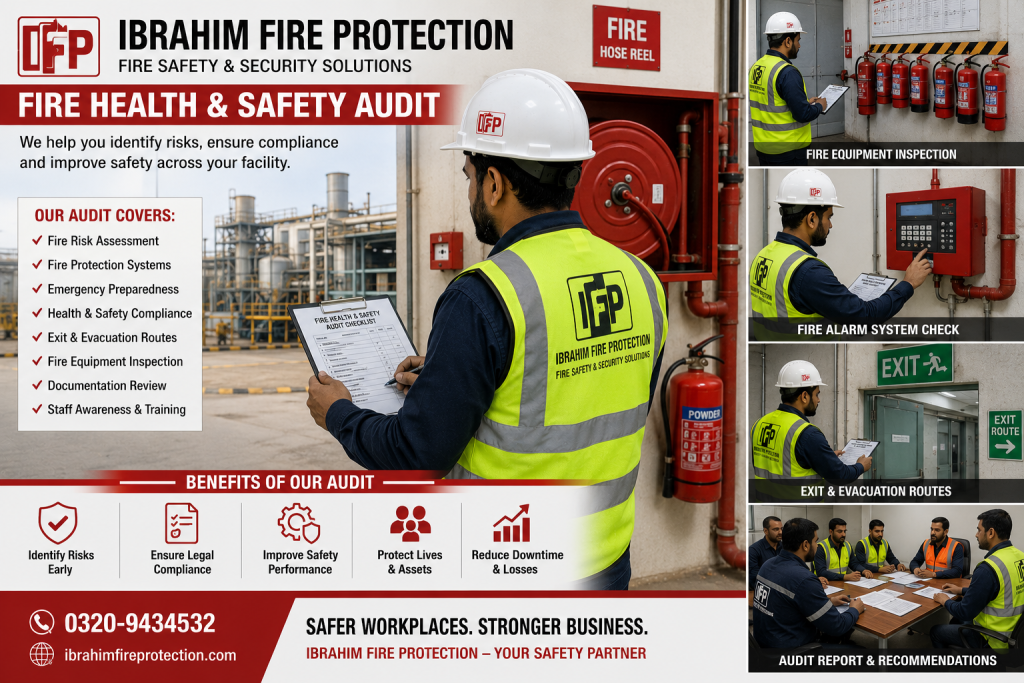
A professional Fire, Health & Safety Audit helps organizations identify fire hazards, workplace safety risks, emergency preparedness gaps, and areas where existing safety measures can be improved.
At Ibrahim Fire Protection, we provide comprehensive Fire, Health & Safety Audit services in Pakistan for commercial buildings, factories, warehouses, offices, hotels, hospitals, schools, restaurants, construction sites, and other workplaces.
Our audits are designed to help businesses identify potential hazards, evaluate existing safety arrangements, and develop practical recommendations for improving workplace and fire safety.
For Fire, Health & Safety Audit services, contact Ibrahim Fire Protection at 0320-9434532.
What Is a Fire, Health & Safety Audit?
A Fire, Health & Safety Audit is a systematic review of a workplace, building, facility, or operation to identify potential hazards and evaluate whether appropriate safety controls are in place.
An audit may examine areas such as:
- Fire protection systems
- Fire detection and alarm systems
- Fire extinguishers
- Fire suppression systems
- Emergency exits
- Evacuation routes
- Emergency lighting
- Fire doors
- Electrical safety
- Workplace hazards
- Personal protective equipment (PPE)
- Emergency procedures
- Safety signage
- Housekeeping
- Chemical and hazardous-material storage
- First-aid arrangements
- Emergency preparedness
- Safety documentation and records
The objective is to identify weaknesses before they contribute to an accident, fire, injury, or major property loss.
Why Is a Fire, Health & Safety Audit Important?
Every workplace contains different hazards. A factory may have machinery, electrical equipment, chemicals, and combustible materials, while an office may have electrical, ergonomic, and evacuation-related risks.
Regular safety audits help organizations understand these risks and determine whether existing controls are adequate.
A professional audit can help businesses:
- Identify fire hazards
- Reduce workplace safety risks
- Improve emergency preparedness
- Protect employees and visitors
- Protect property and equipment
- Improve evacuation arrangements
- Identify deficiencies in fire protection equipment
- Strengthen safety procedures
- Improve safety awareness
- Support compliance with applicable requirements
- Reduce the likelihood and potential impact of accidents
Fire Safety Audit
A Fire Safety Audit focuses specifically on the building’s fire prevention, detection, protection, and emergency response arrangements.
Our fire safety audit can assess:
Fire Extinguishers
We inspect the availability, location, accessibility, condition, identification, and service status of fire extinguishers.
The audit may also assess whether the extinguisher types are appropriate for the fire hazards present.
Fire Alarm System
The fire alarm system may be reviewed for:
- Smoke detectors
- Heat detectors
- Manual call points
- Fire alarm control panels
- Sounders
- Strobe lights
- Batteries
- System faults
- Testing and maintenance records
Fire Suppression Systems
Where installed, fire suppression systems may be reviewed, including:
- FM-200 systems
- Clean-agent systems
- CO₂ systems
- Wet chemical systems
- Foam systems
- Dry chemical systems
- Water-based suppression systems
The audit considers system condition, accessibility, inspection status, and maintenance arrangements.
Emergency Exits & Escape Routes
Emergency escape routes are essential for safe evacuation.
The audit may check:
- Exit availability
- Exit accessibility
- Escape route obstructions
- Exit signage
- Emergency lighting
- Stairways
- Exit doors
- Evacuation routes
- Assembly areas
Fire Doors
Fire doors can help limit the spread of fire and smoke between areas.
The audit may assess their condition, accessibility, closing arrangements, signage, and general maintenance.
Emergency Lighting
Emergency lighting should provide adequate illumination for evacuation when normal electrical power is unavailable.
We assess the condition and availability of emergency lighting as part of the overall fire safety review.
Health & Safety Audit
A workplace health and safety audit examines hazards that could cause injury, illness, property damage, or operational disruption.
Depending on the workplace, our audit can cover:
Workplace Hazards
Identification of hazards associated with:
- Machinery
- Electrical systems
- Work at height
- Slips, trips, and falls
- Manual handling
- Hot work
- Confined spaces
- Vehicles and material handling
- Chemicals
- Noise
- Dust
- Heat
- Workplace conditions
Personal Protective Equipment (PPE)
We review whether appropriate PPE is available and being used for identified hazards.
Depending on the work environment, PPE may include:
- Safety helmets
- Safety shoes
- Gloves
- Safety glasses
- Face shields
- Hearing protection
- Respiratory protection
- Protective clothing
- Fall protection equipment
Electrical Safety
Electrical hazards can cause fire, electric shock, burns, and serious injuries.
An audit may review:
- Electrical panels
- Cables and wiring
- Temporary connections
- Extension leads
- Electrical equipment
- Earthing arrangements
- Panel accessibility
- Electrical housekeeping
- Warning signs
Chemical Safety
Where hazardous chemicals are used or stored, the audit may review:
- Storage arrangements
- Container labeling
- Safety data information
- Spill controls
- Personal protective equipment
- Emergency response procedures
- Segregation of incompatible materials
- Fire protection arrangements
Housekeeping
Poor housekeeping can create significant fire and workplace hazards.
The audit may identify:
- Blocked emergency exits
- Accumulated waste
- Combustible material storage
- Oil or chemical spills
- Poor material organization
- Obstructed fire equipment
- Unsafe storage practices
Health & Safety Risk Assessment
Risk assessment is an important part of effective workplace safety management.
During an assessment, hazards are identified and evaluated according to factors such as:
- Likelihood of an incident
- Potential severity
- Number of people exposed
- Existing safety controls
- Additional controls required
Recommendations can then be prioritized so that organizations can focus first on significant risks.
Emergency Preparedness Audit
Being prepared for an emergency is just as important as having safety equipment.
Our audit may review:
- Emergency response procedures
- Fire evacuation plans
- Emergency contact information
- Assembly points
- Evacuation responsibilities
- Fire warden arrangements
- First-aid arrangements
- Emergency communication
- Staff training
- Fire drills
- Emergency signage
The purpose is to identify whether employees understand what to do during a fire, accident, medical emergency, or other relevant incident.
Fire & Safety Audit Process
At Ibrahim Fire Protection, our audit process can be structured around the specific needs of the facility.
Step 1: Initial Discussion
We understand the organization’s activities, building type, workforce, operating conditions, and safety concerns.
Step 2: Site Inspection
Our team conducts a physical inspection of relevant areas, equipment, systems, escape routes, workplaces, and safety arrangements.
Step 3: Hazard Identification
Potential fire, health, and workplace safety hazards are identified and documented.
Step 4: Risk Evaluation
Identified hazards are evaluated based on their potential consequences and existing controls.
Step 5: Documentation Review
Where applicable, we review relevant safety documentation, inspection records, maintenance records, emergency procedures, and training documentation.
Step 6: Findings & Recommendations
Audit findings are documented along with practical recommendations for improvement.
Step 7: Corrective Action Planning
Organizations can use the audit findings to prioritize corrective actions and improve their overall safety performance.
Fire, Health & Safety Audit Report
Following an audit, a professional report can provide management with a clear overview of the site’s safety condition.
Depending on the scope, the report may include:
- Audit observations
- Identified hazards
- Fire safety deficiencies
- Workplace safety observations
- Risk considerations
- Photographic evidence where appropriate
- Recommended corrective actions
- Priority areas
- Maintenance recommendations
- Suggested improvement measures
A clear audit report allows management to understand what needs attention and where improvements should be prioritized.
Fire & Safety Audit for Different Industries
Ibrahim Fire Protection can provide audit services for a variety of workplaces.
Factories & Industrial Facilities
Industrial sites may have machinery, electrical equipment, combustible materials, chemicals, hot work, and other hazards requiring detailed assessment.
Warehouses
Warehouse audits can focus on storage arrangements, combustible materials, fire protection equipment, emergency exits, electrical safety, and housekeeping.
Offices
Office safety audits can assess fire protection, emergency evacuation, electrical hazards, emergency lighting, exits, housekeeping, and workplace conditions.
Hotels
Hotels require particular attention to fire detection, evacuation, emergency lighting, guest safety, fire doors, kitchen hazards, and staff emergency procedures.
Restaurants & Commercial Kitchens
Kitchen audits can focus on cooking equipment, grease accumulation, LPG or fuel systems, fire extinguishers, wet chemical suppression systems, ventilation, and emergency procedures.
Schools & Educational Institutions
Audits can assess fire alarms, emergency exits, evacuation procedures, fire extinguishers, emergency lighting, assembly points, and staff preparedness.
Hospitals & Healthcare Facilities
Healthcare facilities may require detailed consideration of fire protection, emergency evacuation, electrical safety, oxygen-related hazards, accessibility, and occupant vulnerability.
Benefits of Fire, Health & Safety Auditing
A properly conducted audit can help organizations:
Identify hazards early
Find potential problems before they result in accidents or fire.
Improve fire protection
Identify deficiencies in fire alarms, extinguishers, suppression systems, emergency exits, and other protection measures.
Improve workplace safety
Recognize unsafe practices and conditions affecting employees.
Strengthen emergency preparedness
Improve evacuation procedures, emergency response, and staff awareness.
Protect business operations
Reducing safety risks can help minimize the potential for injury, property damage, downtime, and operational disruption.
Support continuous improvement
Regular audits provide management with a structured way to monitor and improve safety performance.
Fire, Health & Safety Audit Services by Ibrahim Fire Protection
Ibrahim Fire Protection provides professional Fire, Health & Safety Audit services in Pakistan.
Our services can include:
- Fire safety audits
- Workplace health & safety audits
- Fire risk assessments
- Workplace hazard identification
- Emergency preparedness assessments
- Fire extinguisher inspections
- Fire alarm system assessments
- Fire suppression system assessments
- Emergency exit inspections
- Emergency lighting checks
- Electrical safety observations
- PPE assessments
- Housekeeping inspections
- Safety documentation review
- Corrective action recommendations
- Audit reporting
Our approach can be tailored to the size, industry, hazards, and specific requirements of your organization.
Fire, Health & Safety Audit in Pakistan
Ibrahim Fire Protection provides fire and safety audit services in major cities and areas across Pakistan, including:
- Islamabad
- Rawalpindi
- Lahore
- Karachi
- Faisalabad
- Peshawar
- Quetta
- Multan
- Gujranwala
- Sialkot
- Hyderabad
- Gilgit
- Muzaffarabad
- Gwadar
- Other areas of Pakistan
Service availability depends on project requirements and location.
Why Choose Ibrahim Fire Protection?
A safety audit should provide more than a checklist. It should help management understand the actual risks present at the facility and identify practical improvements.
Ibrahim Fire Protection focuses on:
- Professional site inspections
- Practical safety recommendations
- Fire protection expertise
- Workplace hazard identification
- Detailed audit observations
- Clear reporting
- Safety-focused solutions
- Support for corrective actions
Our goal is to help organizations develop safer workplaces and stronger fire protection arrangements.
Book a Fire, Health & Safety Audit
Fire and workplace safety risks can change as buildings, equipment, processes, and employees change. Regular auditing helps organizations identify these changes and respond appropriately.
Whether you operate a factory, warehouse, office, hotel, restaurant, school, hospital, commercial building, or industrial facility, Ibrahim Fire Protection can help assess your fire, health, and workplace safety arrangements.
Need a Fire, Health & Safety Audit?
Contact Ibrahim Fire Protection to arrange a professional site assessment and discuss your audit requirements.
Call: 0320-9434532
Ibrahim Fire Protection — Professional Fire Protection, Health & Safety Solutions in Pakistan.