Fire Extinguisher Refilling
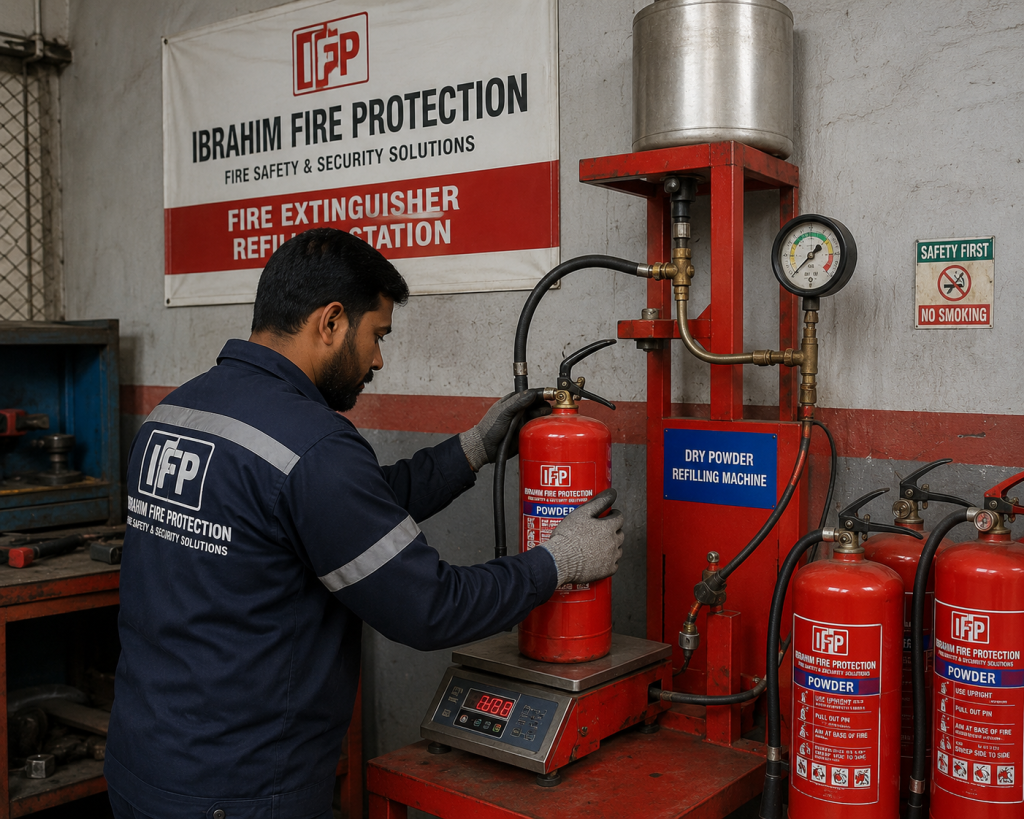
Fire Extinguisher Refilling in Pakistan: Complete Guide
A fire extinguisher is only reliable when it is properly inspected, maintained, and ready to operate. A cylinder may look perfectly fine from the outside while losing pressure, developing internal corrosion, experiencing powder caking, or having a damaged seal or valve.
When a fire occurs, these hidden problems can make the difference between controlling a small fire and facing serious property damage.
That is why fire extinguisher refilling in Pakistan should be treated as an essential part of your ongoing fire safety program—not simply as a one-time purchase.
Whether you operate a textile factory in Faisalabad, a restaurant in Lahore, a corporate office in Islamabad, a warehouse in Karachi, or a school in Peshawar, your fire extinguishers should be regularly inspected and professionally serviced to ensure they remain emergency-ready.
Ibrahim Fire Protection provides professional fire extinguisher inspection, refilling, maintenance, and related fire safety services for commercial, industrial, residential, and institutional facilities.
Why Fire Extinguisher Refilling Is Important
A fire extinguisher depends on several components working together correctly. The extinguishing agent must be suitable for the intended fire risk, the cylinder must be in good condition, and the unit must have sufficient pressure or charge to discharge effectively.
Over time, several problems can develop:
Loss of pressure: Small leaks around valves, seals, or connections can reduce operating pressure.
Powder caking: Moisture and unsuitable storage conditions can cause dry chemical powder to clump.
Agent deterioration: Certain foam, wet chemical, and other extinguishing agents can deteriorate over time.
Corrosion: Humidity, chemicals, and harsh industrial environments can damage cylinders, valves, and internal components.
Accidental or partial discharge: Even limited use can reduce the extinguisher’s effectiveness.
Damaged components: Hoses, nozzles, safety pins, gauges, and tamper seals can become damaged or deteriorate.
A quick visual check cannot always identify these problems. Professional servicing can include checking the extinguisher’s condition, charge or weight, pressure, hose, valve, safety mechanism, and extinguishing agent as appropriate for the specific model.
Types of Fire Extinguishers and Refilling Requirements
Different fire extinguishers use different extinguishing agents and are designed for different fire risks. They therefore cannot all be refilled in the same way.
Dry Chemical Powder (DCP) Fire Extinguishers
DCP fire extinguishers are widely used in offices, factories, shops, warehouses, commercial buildings, and vehicles.
Depending on their rating and agent formulation, DCP extinguishers can be suitable for fires involving ordinary combustibles, flammable liquids, and energized electrical equipment.
Professional DCP servicing generally involves:
Safely discharging and depressurizing the extinguisher where required
Inspecting the cylinder for corrosion, dents, or other damage
Checking the valve, hose, nozzle, safety pin, and tamper seal
Checking the extinguishing powder for condition and contamination
Recharging with the correct agent and specified quantity
Repressurizing to the manufacturer’s specified requirements
Checking the completed unit for proper operation and leakage
Using the wrong powder, incorrect quantity, or improper pressure can affect the extinguisher’s performance. DCP units should therefore be serviced by trained personnel using appropriate equipment.
Carbon Dioxide (CO₂) Fire Extinguishers
CO₂ fire extinguishers are commonly installed near electrical equipment, electrical panels, generators, laboratories, and sensitive equipment because carbon dioxide leaves little to no residue after discharge.
CO₂ extinguishers are different from many pressurized dry chemical units. Their charge is primarily verified by weight, according to the manufacturer’s specifications, rather than relying solely on a conventional pressure gauge.
Professional CO₂ servicing should include checking the cylinder, valve, horn, safety components, and charge weight before returning the unit to service.
Water Fire Extinguishers
Water extinguishers are intended primarily for Class A fires, such as those involving paper, wood, cardboard, and textiles.
They should not be used on energized electrical equipment or fires involving flammable liquids unless the specific extinguisher is expressly designed and rated for that application.
Depending on the extinguisher design, servicing may involve draining the old contents, inspecting the cylinder and internal components, refilling with the specified agent or water-based solution, and restoring the required operating pressure.
Foam / AFFF Fire Extinguishers
Foam extinguishers, including certain AFFF formulations, can be used for appropriate Class A and Class B fire risks.
They are particularly useful in applications where flammable liquids are present because the foam can help separate the fuel surface from oxygen and reduce the risk of reignition.
Servicing may require:
Removing the existing charge
Inspecting and cleaning the cylinder where necessary
Checking the valve and hose assembly
Adding the correct foam concentrate and water mixture according to manufacturer specifications
Repressurizing the extinguisher correctly
The correct foam formulation and concentration are important. Extinguishers should never be refilled with an incompatible agent.
Clean Agent / Halotron Fire Extinguishers
Clean-agent extinguishers are designed for locations where residue from conventional dry powder or foam could damage sensitive equipment or valuable materials.
They may be suitable for environments such as:
Server rooms
Control rooms
Laboratories
Telecommunications areas
Electronics facilities
Museums and archives
Servicing these extinguishers requires specialized equipment and accurate charging procedures. Clean-agent cylinders should be handled by trained technicians familiar with the specific extinguisher and manufacturer’s requirements.
Wet Chemical Fire Extinguishers
Wet chemical extinguishers are designed for commercial kitchens and cooking-oil or fat fire risks.
They are commonly found in:
Restaurants
Hotels
Catering facilities
Commercial kitchens
Food-processing facilities
Wet chemical agents are formulated to cool hot cooking oils and create a surface layer that helps prevent reignition.
A standard DCP or CO₂ extinguisher should not automatically be treated as a substitute for a properly selected wet chemical extinguisher where cooking-oil fire hazards exist.
When Should a Fire Extinguisher Be Refilled?
There is no single refill schedule that applies to every extinguisher. Servicing requirements depend on the extinguisher type, manufacturer instructions, condition, usage, installation environment, and applicable fire-safety requirements.
As part of a good fire safety program, facilities should consider the following:
- Regular Visual Checks
Extinguishers should be visually checked regularly to identify obvious problems such as:
Missing or damaged safety pins
Broken tamper seals
Damaged hoses or nozzles
Visible corrosion
Physical damage
Obstructed access
Leakage
Pressure indication outside the acceptable range, where a gauge is fitted
- Professional Servicing
A qualified technician should periodically inspect and service extinguishers according to the manufacturer’s instructions and applicable standards.
Professional servicing can identify problems that are not obvious during a basic visual inspection.
- Refill After Any Discharge
An extinguisher should be professionally serviced after use—even if only a small amount of agent was discharged.
A partially discharged extinguisher may no longer have sufficient pressure or extinguishing agent for an emergency.
- Follow Manufacturer and Applicable Testing Requirements
Fire extinguishers and their cylinders may have specific inspection, maintenance, and pressure-testing requirements. These should be followed according to the manufacturer’s instructions and the applicable standards and local requirements.
Why the Installation Environment Matters
The environment in which an extinguisher is installed can affect its condition.
For example, equipment installed in a humid coastal or industrial environment may be exposed to more corrosion and moisture than equipment kept in a clean, climate-controlled office.
Special attention may be required in locations such as:
Coastal warehouses
Textile and manufacturing facilities
Chemical plants
Workshops
Commercial kitchens
Outdoor areas
High-humidity storage facilities
Regular inspection helps identify environmental damage before it affects emergency performance.
Fire Extinguisher Refilling Process
Professional extinguisher servicing is more than simply adding powder or pressure to a cylinder.
Depending on the extinguisher type and its condition, the process may include:
Step 1: Initial Inspection
The technician checks the extinguisher’s model, rating, physical condition, service history, and suitability for its intended application.
Step 2: Safe Discharge and Depressurization
Where required, the extinguisher is safely discharged and depressurized using appropriate procedures and equipment.
Step 3: Cylinder Inspection
The cylinder is checked for corrosion, dents, damage, leakage, and other conditions that could affect its safe operation.
Step 4: Valve and Component Inspection
The valve, hose, nozzle, safety pin, tamper seal, pressure gauge, and other relevant components are inspected.
Step 5: Agent Inspection or Replacement
The extinguishing agent is checked and, where required, replaced with the correct type and quantity specified for that extinguisher.
Step 6: Recharging
The unit is recharged according to the manufacturer’s specified requirements for the agent and operating pressure or charge weight.
Step 7: Final Inspection
The completed extinguisher is checked before being returned to service, and service documentation or identification is updated as appropriate.
Fire Extinguisher Refilling Cost in Pakistan
The cost of fire extinguisher refilling in Pakistan can vary depending on several factors, including:
Extinguisher type
Cylinder size and capacity
Extinguishing agent required
Condition of the cylinder
Replacement parts required
Inspection and testing requirements
Quantity of extinguishers
Location and transportation requirements
For this reason, the most accurate approach is to have the extinguishers inspected before receiving a quotation.
At Ibrahim Fire Protection, customers can request an assessment of their extinguishers and receive service recommendations based on the type, condition, and application of each unit.
Common Fire Extinguisher Maintenance Mistakes
Many businesses make avoidable mistakes when managing fire extinguishers.
Ignoring a Low-Pressure Indicator
If a gauge indicates that an extinguisher is outside its acceptable operating range, it should not simply be left in place because the cylinder looks fine.
Refilling With the Wrong Agent
Different fire risks require different extinguishing agents. Refilling an extinguisher with an unsuitable material can compromise its effectiveness.
Reusing an Extinguisher After Discharge
A partially discharged extinguisher should be serviced rather than returned to its mounting location.
Ignoring Corrosion
Rust or corrosion on the cylinder, valve, or base should be taken seriously. Depending on its severity and location, the extinguisher may require further inspection or replacement.
Choosing a Service Provider Based Only on Price
The cheapest refill is not necessarily the safest option. Fire extinguisher servicing involves pressure, specialized agents, valves, cylinders, and safety-critical components.
A professional provider should be able to explain what was inspected, what service was performed, and what requirements apply to the extinguisher.
How to Choose a Fire Extinguisher Refilling Company in Pakistan
Before choosing a fire protection company, consider whether it can provide:
Trained and experienced technicians
Proper servicing and charging equipment
Correct extinguishing agents
Inspection and maintenance documentation
Appropriate pressure and weight checks
Cylinder inspection and testing where required
Replacement parts when necessary
On-site or workshop servicing options
Support for commercial and industrial facilities
Clear service recommendations
A reliable fire protection company should focus on the actual condition and safety of the extinguisher, rather than simply refilling every cylinder without inspection.
Fire Extinguisher Refilling Services by Ibrahim Fire Protection
Ibrahim Fire Protection helps businesses and organizations maintain their fire extinguishers and improve their overall fire readiness.
Our services can support a wide range of facilities, including:
Factories and manufacturing plants
Textile mills
Warehouses and logistics facilities
Offices and corporate buildings
Restaurants and commercial kitchens
Schools and educational institutions
Hotels and commercial properties
Shops and retail premises
Residential and multi-story buildings
Industrial facilities
Whether you have a single extinguisher or a large fleet of units across multiple locations, proper inspection and servicing can help ensure your fire protection equipment is ready when it matters most.
Keep Your Fire Extinguishers Emergency-Ready
Having fire extinguishers installed is only the first step. They need to remain accessible, correctly selected, properly maintained, and ready for immediate use.
A cylinder that looks fine on the outside may still have internal problems that affect its performance. Regular inspection, professional servicing, correct refilling, and appropriate testing help reduce that risk.
If your fire extinguishers are due for service, have been discharged, show signs of corrosion or damage, or have been sitting unused for an extended period, contact Ibrahim Fire Protection for professional fire extinguisher inspection and refilling services in Pakistan.
Protect your people. Protect your property. Keep your fire extinguishers ready for the moment they are needed.
Contact Ibrahim Fire Protection
Need fire extinguisher refilling, inspection, maintenance, or testing?
Contact Ibrahim Fire Protection today to discuss your requirements and arrange professional fire extinguisher servicing for your facility.